
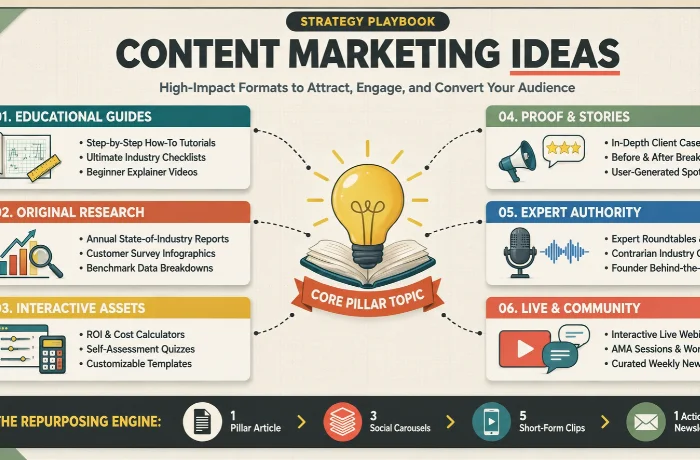
Finding fresh content marketing ideas becomes difficult when every brand appears to publish the same tips, videos, and social posts. The better approach is choosing formats that solve real customer questions while supporting a measurable business goal. You also need a system that can produce useful material consistently.
For U.S. businesses, the strongest ideas usually connect audience needs with a clear stage of the buying journey. A useful piece can attract new visitors, build trust, support a purchase, or retain existing customers. The format matters less than the purpose behind it.
Direct answer: Start with customer questions, original expertise, case studies, short videos, useful templates, and first-party data. Match each format to a business goal before publishing. Then repurpose strong material across search, email, social media, and video instead of creating every piece from scratch.
Content Ideas at a Glance
| Idea | Best Goal | Useful Format | Effort |
|---|---|---|---|
| Customer question articles | Search visibility | Blog or FAQ | Low |
| Original research | Authority | Report or article | High |
| Case studies | Conversion | Article or video | Medium |
| Short educational videos | Reach | Reels, Shorts, TikTok | Medium |
| Comparison content | Consideration | Guide or table | Medium |
| Templates and checklists | Lead generation | Downloadable resource | Medium |
| Expert interviews | Trust | Article, video, podcast | Medium |
| Behind-the-scenes content | Brand connection | Social video | Low |
| Email mini-series | Nurturing | Medium | |
| User-generated content | Social proof | Social posts | Low |
| Myth-busting articles | Search and trust | Blog | Low |
| Interactive tools | Leads and links | Calculator or quiz | High |
| Repurposed pillar content | Efficiency | Multichannel | Low |
| Trend commentary | Awareness | Blog or LinkedIn | Low |
| Customer onboarding content | Retention | Guide or email | Medium |
Key Takeaways
- Choose an audience problem before choosing a format.
- Connect every piece to awareness, consideration, conversion, or retention.
- Build recurring formats instead of relying on one-off inspiration.
- Use original experience, data, examples, and customer questions whenever possible.
- Repurpose strong material across several channels.
- Track business outcomes, not publishing volume alone.
Google advises publishers to create useful material primarily for people rather than search rankings. It also encourages original information, clear sourcing, and meaningful added value. Those principles make a strong foundation for any publishing plan.
How to Choose Content Marketing Ideas That Fit Your Goal

Start by identifying what you want the next piece to accomplish. Content Marketing Ideas content should help new people discover your brand. Conversion content should answer concerns that prevent qualified prospects from acting.
Then consider where your audience already looks for information. Search may suit detailed guides, while short video can work better for demonstrations. Email can support prospects who already know your company.
FJREO’s broader guide to digital marketing strategies explains how search, social media, email, advertising, and related channels can work together. Your publishing plan should support those channels rather than exist separately. That connection makes each asset more useful.
1. Answer Real Customer Questions
Your sales inbox can become one of your strongest idea sources. Record questions prospects repeatedly ask about pricing, timing, features, risks, or alternatives. Turn each recurring question into a focused article or video.
This method reduces guesswork because the demand already exists. It can also support sales conversations after publication. Sales teams can send useful answers instead of rewriting the same explanation.
2. Publish Original Research
Original data gives readers something they cannot find on every competing website. You might survey customers, analyze anonymized usage patterns, or summarize industry benchmarks. Even a small study can become useful when the methodology is clear.
One dataset can support several assets. Publish the full findings, individual charts, short social posts, and an email summary. Report limitations honestly so readers understand what the numbers mean.
3. Build Customer Case Studies
A case study shows how a specific problem was solved. Focus on the starting situation, the actions taken, and the resulting change. Use verified numbers when the customer allows them.
Avoid turning every story into an advertisement. Readers want enough context to judge whether the example resembles their situation. Quotes and screenshots can strengthen credibility when you have permission.
4. Create Short Educational Videos
A useful video can answer one narrow question in less than a minute. Demonstrate a process, define a term, or correct a common mistake. Keep the opening focused on the problem instead of your company.
One recording session can produce several clips. Add captions because many viewers watch without sound. You can also embed useful clips inside related articles.
5. Write Honest Comparison Pages
People often compare approaches before they choose a provider or product. Create pages that explain meaningful differences across price, use case, difficulty, speed, or limitations. State clearly which option suits each type of buyer.
Fair comparisons can build more trust than aggressive sales copy. Include situations where another option may be better. That honesty can improve the quality of leads you receive.
6. Offer Useful Templates and Checklists
Templates help readers complete a task instead of merely learning about it. Examples include planning sheets, audit checklists, calculators, briefs, and email scripts. Keep the resource simple enough to use immediately.
A downloadable asset can also support lead generation. Ask only for information your follow-up process genuinely needs. Too many form fields can create unnecessary friction.
7. Interview Practitioners and Specialists
Expert interviews add perspectives your editorial team may not have. Ask questions based on practical experience instead of requesting broad predictions. Strong answers often contain examples, mistakes, and decision criteria.
The interview can become an article, podcast episode, video, and social clips. Give contributors clear attribution. Their participation may also expand distribution.
8. Show the Work Behind Your Business
Behind-the-scenes material can make a company easier to understand. Show how a product is prepared, how a service is delivered, or how quality is checked. Avoid manufacturing drama for attention.
This format works well for companies with visual processes. It can also introduce the people responsible for important work. Clear demonstrations often create stronger trust than polished claims.
9. Build a Short Email Learning Series
Create a sequence that teaches one useful subject across several emails. Each message should solve a distinct part of the reader’s problem. The sequence can lead naturally toward a product, consultation, or related guide.
Email also gives you a direct audience connection. That matters because social distribution can change without warning. Keep each email focused on one practical takeaway.
10. Turn Customer Contributions Into Content
Reviews, customer photos, questions, and stories can become useful publishing material. Always get permission before using identifiable customer information. Add context so the contribution teaches something.
User-generated material can provide social proof without forcing a sales message. It can also encourage community participation. Create simple submission guidelines to maintain quality.
11. Publish Myth-versus-Fact Articles
Every industry has assumptions that customers repeat. Pick one misconception and explain what is accurate, what is misleading, and what depends on context. Use reputable sources for factual claims.
This format works because it addresses existing confusion. It can also produce strong search-focused headings. Avoid inventing controversy simply to create a headline.
12. Build a Simple Interactive Tool
A calculator, quiz, estimator, or assessment can turn passive reading into action. The tool should help users make a real decision. Complex technology is unnecessary when a simple formula solves the problem.
Interactive resources can also support sales qualification. For example, a cost estimator can prepare prospects before a consultation. Explain how results are calculated so users can judge them properly.
13. Repurpose One Strong Resource
A detailed guide can become several smaller assets. Pull out individual tips, charts, questions, examples, and short videos. Adapt each version to the channel instead of copying identical text everywhere.
This approach lowers production pressure. It also gives strong ideas more chances to reach people. A useful article should not disappear after one promotional post.
14. Comment on Relevant Trends
Timely commentary works when your company has something useful to add. Explain what changed, who it affects, and what readers should do next. Skip trends that have no connection to your audience.
Speed matters, but accuracy matters more. Verify announcements before publishing your interpretation. Update the page when important facts change.
15. Create Better Customer Onboarding Content
Marketing does not end after a purchase. New customers often need instructions, expectations, troubleshooting, and examples. Clear onboarding material can reduce confusion and support retention.
These resources can include welcome emails, setup videos, checklists, and knowledge-base articles. Good onboarding also reveals new topics for future publishing. Repeated support questions show where explanations need improvement.
Connect Organic Content With Paid Promotion
Organic publishing and advertising can support each other. A useful guide can introduce prospects before a paid retargeting campaign reaches them later. High-performing paid messages can also reveal topics worth covering organically.
FJREO’s article on using digital advertising in a business plan covers targeting, measurement, and customer relationships. Businesses running ecommerce campaigns can also review the site’s ecommerce PPC agency guide. Together, these resources help connect owned content with paid acquisition.
Use a Simple Four-Stage Content Mix
A balanced calendar should support more than traffic. Assign every planned asset to awareness, consideration, conversion, or retention. This prevents the common problem of publishing many top-of-funnel articles without helping buyers move forward.
| Funnel Stage | Useful Formats | Example Goal |
|---|---|---|
| Awareness | Educational articles, short videos, trend commentary | Reach new audiences |
| Consideration | Comparisons, interviews, research | Build confidence |
| Conversion | Case studies, calculators, buying guides | Support action |
| Retention | Onboarding guides, email education, customer stories | Keep customers successful |
Review the mix once each month. If every asset sits in one stage, your calendar may be unbalanced. Adjust future topics rather than publishing more of the same.
How to Measure Whether an Idea Worked
Choose one primary metric before production starts. Awareness pieces may use qualified organic visits or video reach. Conversion assets should focus more on leads, sign-ups, assisted sales, or revenue.
Look at quality as well as volume. A smaller article that influences several sales may matter more than a high-traffic post. Compare performance against the original purpose of the asset.
Use patterns to guide future planning. If customer-question articles repeatedly generate qualified visits, expand that format. If another series consistently underperforms, revise it or stop producing it.
Build a Repeatable Idea System
The strongest content marketing ideas are useful enough to repeat, adapt, and measure. Build your calendar from customer problems rather than random publishing quotas. Then use performance data to decide which formats deserve more investment.
Start with three ideas from this list and assign each one a goal. Publish them across the channels your audience already uses. Review the results, improve the winners, and turn successful formats into recurring series.
Frequently Asked Questions
What are the best content marketing ideas for a small business?
Start with customer questions, helpful how-to articles, short videos, case studies, checklists, and customer stories. These formats can be created without a large production team. Choose two or three repeatable formats before adding more.
How often should a business publish new content?
There is no universal publishing frequency that guarantees results. Choose a schedule your team can maintain without lowering quality. Consistent useful work is usually more sustainable than short bursts of daily publishing.
How can I find new topics without guessing?
Listen to sales calls, customer emails, reviews, search queries, support tickets, and competitor gaps. Record recurring questions in one shared idea bank. Rank them by audience importance and connection to business goals.
Should businesses use AI to create marketing content?
AI can help organize research, summarize notes, generate outlines, and reshape existing material. Human review remains necessary for accuracy, originality, and useful judgment. Google specifically advises checking AI-assisted material for quality, relevance, and factual accuracy.
How do I repurpose one article into several pieces?
Start with the strongest sections, examples, questions, and visuals inside the article. Turn those elements into short videos, emails, social posts, checklists, or presentation slides. Adapt each version to its channel rather than copying the article word for word.