
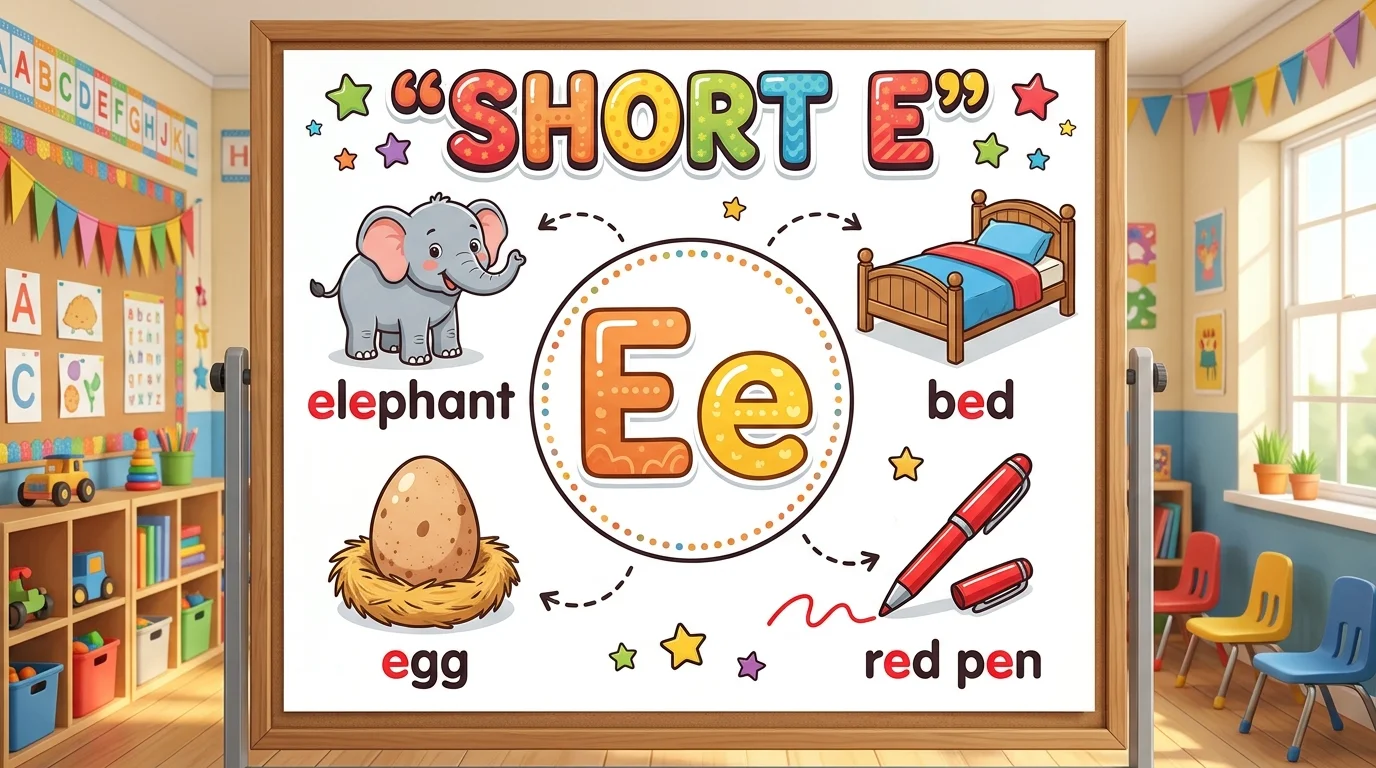
Learning the short e pattern helps beginning readers decode many common English words. You hear it in words such as bed, red, pen, and ten. The sound is commonly represented as /ɛ/ in pronunciation guides.
The letter e often represents /ɛ/ inside a closed, stressed syllable, as in bed, pen, and get. Readers can practice it through simple CVC words, rhyming families, sound blending, and word sorting. Comparing words like pen and pin also helps children hear nearby vowel sounds more accurately.
Quick Facts
| Key point | Explanation |
|---|---|
| Common sound | /ɛ/, as in bed |
| Typical pattern | Closed syllable |
| Beginner examples | bed, red, pen, ten, net |
| Common word families | -ed, -en, -et, -eg |
| Common confusion | The vowel sound in sit |
| Useful practice | Blending, rhyming, sorting, and reading aloud |
| Typical learners | Pre-K, kindergarten, and early elementary readers |
Educational resources describe this vowel as common in simple closed syllables. Michigan Learning Channel uses examples such as web and bed when teaching young learners. Pronunciation guides also distinguish this sound from other English vowel sounds. For more learning topics, browse the education archives on FJREO.
How the Short E Sound Works
A closed syllable ends with one or more consonants after its vowel. In a word like bed, the consonant d closes the syllable after e. That spelling pattern often signals the /ɛ/ pronunciation.
The word pen follows the same basic structure. Its sounds can be separated as /p/, /ɛ/, and /n/. Blending those sounds smoothly creates the complete spoken word.
The word “short” does not simply describe how long you hold the vowel. It is a traditional phonics label for a group of vowel pronunciations. American English pronunciation resources make this distinction when explaining short vowels.
Common CVC Words With the /ɛ/ Vowel
CVC means consonant-vowel-consonant. These words are useful because beginning readers can usually sound out each letter in sequence. Grouping them by ending also makes rhyming patterns easier to notice.
| Word family | Practice words |
|---|---|
| -ed | bed, fed, led, red, wed |
| -en | den, hen, men, pen, ten |
| -et | bet, get, jet, let, met, net, pet, set, vet, wet, yet |
| -eg | beg, leg, peg |
| Other simple patterns | hem, web, yes, hex |
These groups closely match decodable word lists used for beginning phonics practice. Words such as bed, hen, net, and leg give learners predictable patterns. That predictability lets children focus on blending rather than memorizing whole words.
More Words for Reading and Spelling Practice
Learners should eventually move beyond three-letter examples. Longer closed syllables help them apply the same vowel knowledge in less predictable settings. The following words provide a useful next step.
- best
- bend
- belt
- desk
- dress
- felt
- fresh
- help
- kept
- left
- next
- rest
- sell
- send
- sent
- smell
- spell
- spend
- step
- tent
- vest
- went
- check
- chest
- blend
Start with a few words instead of presenting the entire list at once. Ask the learner to identify the vowel before sounding out each word. Then have the learner blend the sounds without pausing between every letter.
Why Word Families Make Phonics Easier

Rhyming families let readers reuse a spelling pattern they already understand. A child who reads net can compare it with pet, wet, and jet. Only the first consonant changes in those examples.
This method reduces the amount of unfamiliar information in each new word. It also shows children that English spellings contain repeatable patterns. Decodable lists commonly organize beginner vocabulary this way for the same reason.
Parents can turn word families into a quick oral game. Say bed, then ask the child for another word ending in -ed. Follow with red, fed, or another familiar example.
How to Pronounce the /ɛ/ Vowel Clearly
Keep your lips relaxed and open your mouth slightly. Your tongue should remain toward the front and middle of your mouth. Say bed slowly and pay attention to the vowel between the consonants.
Next, compare pen with pin. The vowel in pen generally uses a slightly more open mouth position. The contrast can help learners who frequently mix these words.
PBS learning material uses mouth positioning while teaching young children vowel contrasts. Lalilo also advises opening the mouth more when learners substitute the vowel in sit. These physical cues can make an abstract sound easier to understand.
Easy Activities for Parents and Teachers
Phonics practice works best when children must listen, read, and make choices. Repeating the same word list alone can become mechanical. Short activities create more opportunities to notice the target vowel.
Try these exercises:
- Sound hunt: Find five classroom or household words containing the target vowel.
- Word sort: Mix words such as pen, pin, bed, and big.
- Build a rhyme: Start with net and create pet, wet, jet, and set.
- Sound boxes: Tap once for each sound in words such as bed or hen.
- Missing vowel: Write b_d or p_n and ask which vowel completes the word.
- Read and match: Match printed words with simple pictures.
- Quick sentences: Use two practice words in one short sentence.
Five focused minutes can provide useful practice without tiring a beginning reader. Repeat difficult contrasts across several sessions rather than forcing mastery immediately. Keep accurate reading more important than speed during early practice.
A Simple Five-Step Practice Routine
A consistent routine makes lessons easier for children to understand. Each step should focus on one manageable action. You can repeat the routine with different words on later days.
- Say the vowel sound. Model /ɛ/ with a familiar example such as bed.
- Identify the vowel. Show several words and ask learners to find e.
- Blend the sounds. Read each consonant and vowel before combining them.
- Compare close sounds. Contrast pairs such as pen/pin and set/sit.
- Read in context. Put familiar practice words into simple sentences.
This sequence moves from hearing toward connected reading. It also provides several chances to notice mistakes before they become habits. Teachers can shorten or repeat individual steps based on each learner’s progress.
Short E Versus Short I
These two vowel sounds can be difficult for beginning readers to separate. Words such as pen and pin differ by only one vowel sound. Practicing the pair together makes the contrast easier to hear.
| /ɛ/ examples | /ɪ/ examples |
|---|---|
| pen | pin |
| ten | tin |
| bet | bit |
| set | sit |
| hem | him |
Ask children to say each pair slowly before reading it quickly. They can watch their mouth in a mirror while making both sounds. Listening and mouth-position practice together can strengthen the distinction.
Several phonics resources specifically identify this confusion for new readers. The problem is common enough that direct comparison deserves regular practice. Learners should hear both options instead of studying each vowel only in isolation.
When Does the Letter E Make a Different Sound?
The letter e does not always represent /ɛ/. It can represent other sounds in words such as me, these, or unstressed syllables. It may also appear silently in many English spellings.
Context therefore matters when children move beyond basic phonics. Closed syllables provide a strong starting pattern, not a rule covering every English word. Readers gradually learn additional vowel teams and syllable patterns as their skills grow.
That progression is normal during early literacy development. Students first benefit from dependable patterns that support successful decoding. Exceptions and additional spelling patterns can follow after those foundations become familiar.
How Adults Can Support Beginning Readers
Correct mistakes calmly and focus on the sound that caused difficulty. Ask the learner to try the word again rather than immediately giving the answer. A small prompt can encourage independent decoding.
You can also connect phonics practice with broader learning goals. FJREO’s Education section collects education-focused material for students and lifelong learners. Its article about aligning educational choices with personal interests discusses building learning paths around motivation.
FJREO also provides background on education contributor Henry Powell. His profile covers curriculum development, teacher training, and educational policy experience. These resources can help readers explore learning topics beyond early phonics.
Frequently Asked Questions
What is the short e sound?
It is commonly represented as /ɛ/ in American English pronunciation guides. You can hear it clearly in bed, red, pen, and ten. It often appears when e sits inside a closed, stressed syllable.
What are five easy words that use it?
Five beginner-friendly examples are bed, red, hen, net, and leg. Each word gives children a clear vowel surrounded by familiar consonants. They also fit common early phonics and decodable-reading practice.
Is egg an example?
Yes, egg begins with the /ɛ/ vowel in standard American English pronunciation. It is useful because the target sound appears at the beginning. Children may find that position easier to hear than a vowel between consonants.
Why does my child confuse pen and pin?
The two words contain nearby vowel sounds and otherwise share the same consonants. Beginning readers may not hear the contrast consistently at first. Practice them as a pair while using slow pronunciation and mouth-position cues.
What grade usually teaches this vowel pattern?
Short vowel patterns commonly appear in early elementary phonics instruction. Kindergarten and first-grade materials frequently include words such as bed, red, and pen. Individual curricula may introduce or review them at different times.
Build Confidence With Small, Repeated Practice
Early readers do not need enormous word lists in one lesson. They need clear examples, repeated blending, and chances to compare similar sounds. A few minutes of accurate practice can be more useful than a long drill.
Begin with familiar CVC words, then add longer closed-syllable examples. Use rhyming, sorting, sound boxes, and simple sentences to keep practice varied. Return to difficult vowel contrasts until the learner recognizes them comfortably.