
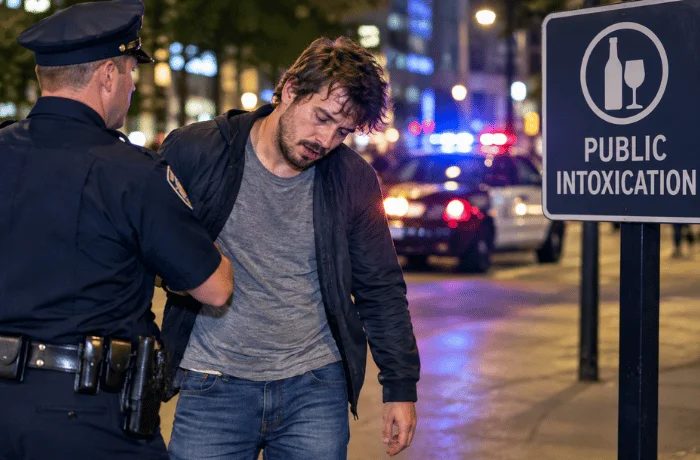
Public intoxication is not governed by one nationwide U.S. rule. States and cities define the offense differently, and some jurisdictions do not criminalize being drunk in public by itself. Where a criminal law applies, authorities often need more than proof that a person consumed alcohol.
Quick answer: Public intoxication generally means appearing impaired in a public place under circumstances prohibited by state or local law, often because the person creates a safety risk, disturbance, or obstruction. There is no single nationwide rule: some jurisdictions criminalize it, while others use civil protective custody or punish related conduct instead.
| Key question | General U.S. answer |
|---|---|
| Is being drunk in public always illegal? | No. State and local rules differ. |
| Is merely drinking alcohol enough? | Often no. Many laws require danger, disruption, obstruction, or another specified condition. |
| Is a 0.08 BAC always required? | No. A chemical test is not a universal requirement. |
| Can the offense be a misdemeanor? | Yes, in jurisdictions that criminalize the conduct. |
| Can police use protective custody instead? | Some states provide civil or treatment-based alternatives. |
| Do local rules matter? | Yes. The exact location and jurisdiction can change the answer. |
Key takeaways
- Being visibly impaired and committing a criminal offense are not always the same thing.
- The meaning of a “public place” depends on the governing statute.
- Danger to yourself or another person is a common issue under many state laws.
- Drinking in public, disorderly conduct, and DUI are separate legal concepts.
- Anyone facing a real citation should check the exact statute listed on the paperwork.
What Public Intoxication Usually Means Under U.S. Law
Most legal definitions start with two basic questions: was the person impaired, and were they in a place covered by the law? Many jurisdictions then require another circumstance, such as danger, disorderly behavior, obstruction, or inability to care for personal safety. The exact elements must come from the statute or ordinance that applies where the incident happened.
A public place can include streets, sidewalks, parks, transportation facilities, and other locations open to the public. Some states also treat bars or other privately owned businesses as public places for this purpose. Readers interested in related legal explanations can browse the FJREO Law section for other U.S. law guides.
What Police and Prosecutors May Need to Establish
A charge usually depends on several facts rather than one observation. The prosecution must prove the elements required by the governing law, while an officer initially needs the level of legal justification required for a stop, citation, detention, or arrest. The details can differ sharply among jurisdictions.
| Issue | What authorities may examine |
|---|---|
| Impairment | Speech, balance, conduct, appearance, statements, or other observations |
| Location | Whether the person was in a legally defined public place |
| Safety risk | Whether the person could endanger themselves or someone else |
| Conduct | Fighting, blocking passage, creating a disturbance, or similar behavior |
| Evidence | Officer observations, witnesses, video, chemical testing when used, and other facts |
A breath or blood test is not always needed. Texas, for example, says an officer is not required to offer either test before issuing a citation under its rule. The state also defines the offense in its Penal Code chapter on intoxication offenses by requiring a person to appear in a public place while impaired to the degree that the person may endanger themselves or another.
Why the State Can Completely Change the Outcome
California shows one criminal-law approach. Penal Code section 647(f) applies when a person in a public place is under the influence and cannot care for personal safety or the safety of others or obstructs a street, sidewalk, or other public way. California law also provides for civil protective custody in specified circumstances when an appropriate facility is available.
Texas uses a different test, while Nevada takes a substantially different policy approach. Nevada Revised Statutes section 458.260 states, subject to listed exceptions, that being found in an intoxicated condition is not itself a public offense. That statute does not excuse a separate criminal act committed while a person is impaired.
| Example state | General approach | Important point |
|---|---|---|
| California | Criminal offense under specified conditions | Personal safety or obstruction can matter. |
| Texas | Class C misdemeanor when impairment may create danger | TABC states the fine can reach $500. |
| Nevada | Being found drunk is generally not itself a public offense. | Other crimes and statutory exceptions still apply. |
These examples show why a national answer should never be treated as a substitute for local law. Two people displaying similar behavior in different states can face different legal consequences. City ordinances and the precise facts can create further differences.
Possible Penalties and Protective Custody
When the conduct is criminalized, consequences can include a fine, a misdemeanor case, probation, community service, or other court-ordered conditions. Jail exposure depends on the jurisdiction and offense classification, so a national article cannot give one reliable maximum penalty. Prior offenses or additional charges may also affect what happens next.
A police encounter does not always lead to criminal prosecution. Some laws authorize protective or civil custody when the goal is to keep an impaired person safe until the immediate condition passes. California and Nevada both illustrate ways lawmakers can use a health or protective response rather than relying only on a standard criminal case.
Being Drunk, Drinking in Public, Disorderly Conduct, and DUI Are Different
Being impaired in a public setting should not be confused with openly consuming alcohol. A jurisdiction may restrict drinking from an open container even when the person does not appear impaired. A person may also violate a disorderly conduct law through disruptive behavior even where simple drunkenness is not independently criminal.
Driving under the influence is a separate category because it concerns operating or controlling a vehicle under an impaired-driving law. Likewise, an argument that becomes physical can create separate assault or battery issues regardless of alcohol use. FJREO’s guide to battery law explains how unwanted physical contact can create its own criminal or civil questions.
| Situation | Main legal focus |
|---|---|
| Being drunk in a covered public place | Impairment plus the elements required by local law |
| Drinking in a prohibited place | Where alcohol may legally be consumed |
| Disorderly conduct | Disruptive or prohibited public behavior |
| DUI or DWI | Operating or controlling a vehicle while impaired |
| Assault or battery | Threatened or actual unlawful physical conduct |
This distinction matters because one night can produce more than one allegation. A person might face an alcohol-related citation plus a separate charge for fighting, trespassing, property damage, or another act. Each charge has its own elements and possible defenses.
Common Defense Issues in a Drunk-in-Public Case
A charge is an allegation, not proof that every element has been established. Defense questions often focus on whether the person was legally impaired, whether the location qualified as public, and whether the statute required danger or disruptive conduct. Evidence such as video, witnesses, medical information, and officer reports can become important depending on the case.
| Defense issue | Question to examine |
|---|---|
| Evidence of impairment | What facts support the claim that the person was impaired? |
| Public-place element | Did the location meet the statute’s definition? |
| Required danger or disruption | Did the alleged conduct satisfy that additional element? |
| Medical explanation | Could a medical condition or prescribed treatment explain the observed behavior? |
| Evidence problems | Are witness accounts, recordings, and officer observations consistent? |
No defense works automatically, and legal standards vary by state. A person should avoid assuming that one defense described online applies to a particular case. The charging document and current local statute provide a better starting point.
What to Do After a Citation or Arrest
Start by identifying the exact statute, ordinance, or code section written on the citation or charging paperwork. Keep the documents, court notices, receipts, photographs, videos, and contact information for witnesses together. Avoid missing a court date, because a minor original charge can become more complicated when required appearances are ignored.
Next, check whether the case involves only a low-level citation or a separate custody and release process. Bail practices depend on the jurisdiction and the charge, so a bond is not required in every case. When bail is relevant, FJREO’s guide to choosing a bail bonds service explains common considerations before signing an agreement.
Frequently Asked Questions
Is public intoxication a federal crime?
There is no single federal criminal rule that governs ordinary drunk-in-public cases across all 50 states. These incidents are generally handled through state statutes and local ordinances. Federal law can still apply to separate conduct or in particular federal jurisdictions, so location remains important.
Can you be arrested simply because you have been drinking?
Not necessarily. Many laws require a specified level of impairment plus danger, disruption, obstruction, or another condition. Some states also use civil protective custody instead of treating drunkenness by itself as a crime.
Does a police officer need a 0.08 BAC result?
No universal 0.08 threshold applies to every drunk-in-public case. Texas includes a 0.08 alcohol concentration within its definition of being intoxicated, yet TABC states that a breath or blood sample is not required before a citation. Other states use statutory tests based on behavior, safety, or obstruction rather than a universal BAC number.
Can a drunk-in-public charge go on your record?
That depends on whether the event produces a criminal charge, conviction, civil detention, dismissal, or another outcome under local law. Record rules, sealing procedures, and expungement eligibility also differ by jurisdiction. Anyone concerned about employment, licensing, immigration, or background checks should get advice based on the specific state and case outcome.
The Bottom Line
Being drunk in a public setting does not produce the same legal result everywhere in the United States. The key questions are where the incident occurred, what the local law requires, what conduct officers observed, and whether the jurisdiction treats the situation as a crime or a protective-health matter. California, Texas, and Nevada show how different those answers can be.
If you are dealing with a public intoxication charge, read the exact code section on your paperwork and confirm the current law in that jurisdiction. A licensed local criminal defense attorney can explain deadlines, possible defenses, record consequences, and court procedures based on the facts.