
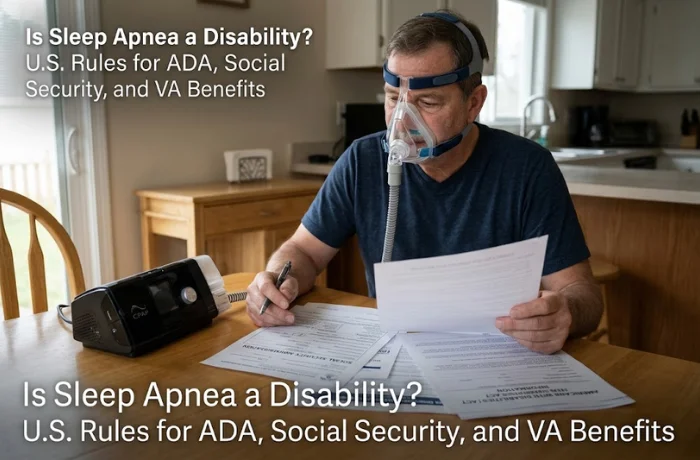
If you’re wondering is sleep apnea a disability, the answer depends on the program involved. A diagnosis alone does not automatically qualify someone for every type of disability protection or benefit. In the United States, ADA protection, Social Security benefits, and VA compensation each use different eligibility rules.
Direct answer: Sleep apnea can qualify as a disability in the United States, but qualification is not automatic. The ADA focuses on substantial limits to major life activities. Social Security examines whether medical limitations prevent substantial work for at least 12 months. VA compensation requires a service-connected condition and uses its own rating schedule.
| Disability context | Can the condition qualify? | Main test |
|---|---|---|
| Americans with Disabilities Act | Yes, in some cases | Substantially limits a major life activity |
| Social Security SSDI or SSI | Yes, in severe cases | Prevents substantial work under SSA rules |
| VA disability compensation | Yes | Must be service connected and meet VA rating rules |
| Private disability insurance | Possibly | Depends on the policy definition |
| FMLA medical leave | Possibly | Separate eligibility and serious-health-condition rules |
Key Takeaways
- A medical diagnosis and a legal disability are not the same thing.
- The ADA specifically recognizes sleeping and breathing as major life activities.
- Social Security evaluates complications and work-related limitations rather than using a standalone listing.
- Strong medical records should explain symptoms, treatment, and functional limitations.
- Veterans face a separate service-connection and disability-rating process.
- Private insurance and medical leave programs use their own definitions.
Is Sleep Apnea a Disability Under the ADA?
Under the Americans with Disabilities Act, a physical or mental impairment may qualify when it substantially limits a major life activity. Federal law lists sleeping, breathing, concentrating, and working among major life activities. That means a serious sleep-related breathing disorder may meet the ADA definition in an individual case. The ADA uses an individualized assessment rather than a diagnosis-only rule. A person with mild symptoms may not have the same legal status as someone with serious breathing interruptions and daytime impairment. The effect on daily activities matters more than the condition’s name alone.
ADA regulations also state that the disability definition should receive broad coverage. Positive effects from many mitigating measures generally are not considered when deciding whether an impairment substantially limits a major life activity. The U.S. Department of Justice provides more detail in its ADA disability guidance.
What workplace accommodations might be available?
An employee covered by the ADA may request a reasonable accommodation when one is needed because of a qualifying disability. The appropriate accommodation depends on the job, symptoms, essential duties, and workplace. Employers do not have to remove essential job functions or provide accommodations that create an undue hardship. Possible accommodations could involve schedule changes, approved breaks, or another adjustment tied to documented limitations. The correct solution will depend on the person and job involved. Readers interested in related wellness material can also browse FJREO’s health articles.
Can You Get Social Security Disability for Sleep Apnea?
Social Security does not currently provide a standalone adult listing that automatically awards benefits for this diagnosis. Instead, the Social Security Administration evaluates complications in the affected body systems. It may examine pulmonary hypertension, chronic heart failure, cognitive problems, or other documented effects. SSA can also evaluate what a claimant can still do in a work setting through a residual functional capacity assessment. This assessment considers relevant medical evidence and resulting physical or mental limitations. Severe daytime fatigue or concentration problems matter when reliable evidence shows how they restrict sustained work.
For adults, Social Security generally requires an inability to perform substantial gainful activity because of a medically determinable impairment. That impairment must have lasted, or be expected to last, at least 12 continuous months. The agency then applies its established sequential evaluation process. The official SSA respiratory listings explain that sleep-related breathing disorders may produce hypoxemia and other complications. SSA evaluates those complications under the appropriate body-system listing. Readers comparing different benefit systems may also find FJREO’s broader law section useful.
What evidence can strengthen an SSDI or SSI claim?
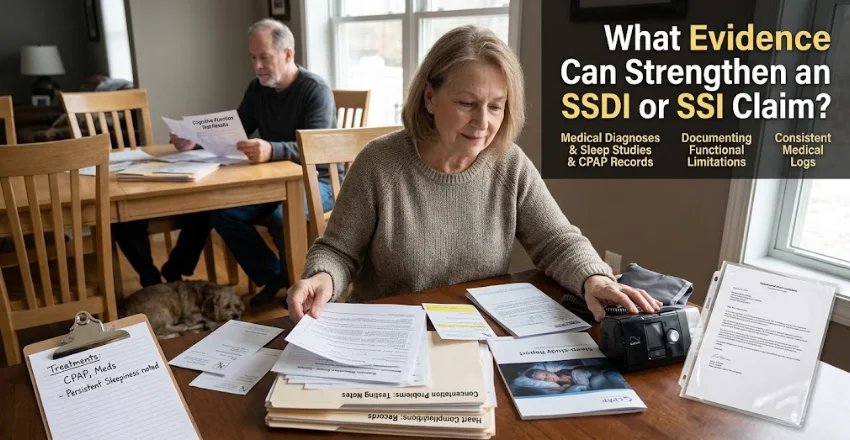
A diagnosis establishes that a medical condition exists, but SSA also needs evidence showing its functional effects. Medical records should give decision-makers enough information to understand severity, treatment history, symptoms, and resulting restrictions. Consistent records are more useful than broad statements saying someone is “disabled.”
Useful evidence may include the following items.
- Sleep-study results and medical diagnoses.
- Treatment records and prescribed therapies.
- Records describing persistent daytime sleepiness.
- Documentation of concentration or memory problems.
- Records of heart, pulmonary, or cognitive complications.
- Statements describing specific work-related limitations.
- Evidence concerning other medical conditions considered together.
A claimant’s full medical picture can matter because SSA considers combined limitations from medically determinable impairments. Long-term conditions often require continuing documentation rather than a single test result. FJREO also has an article discussing chronic care management for readers managing ongoing health needs.
Does Using a CPAP Machine Prevent Disability Eligibility?
Using CPAP does not create an automatic Social Security approval or denial. The central question remains what limitations continue after considering the medical evidence and applicable program rules. Records showing treatment response can therefore become important. Some people experience substantial improvement with treatment, while others may continue having significant documented limitations. Claimants should accurately report prescribed treatment, response, and any medically documented difficulties. A healthcare professional can document the clinical facts, while SSA determines benefit eligibility.
The ADA applies a different analysis. Its rules generally assess whether an impairment substantially limits a major life activity without considering the positive effects of many mitigating measures. This distinction is one reason a person might have ADA protection without qualifying for Social Security payments.
How Severe Does the Condition Need to Be?
There is no single apnea-hypopnea index number that automatically establishes Social Security disability. SSA focuses on the medical evidence, qualifying complications, functional capacity, and ability to perform sustained work. Severity on a sleep study is therefore only part of the record. For ADA purposes, the question is whether the impairment substantially limits a major life activity compared with most people. Federal regulations say this standard should not demand extensive analysis. Still, not every impairment automatically meets the definition. These different rules explain why online answers can appear contradictory. One source may discuss workplace civil rights, while another discusses monthly disability benefits. Identifying the program first makes the answer much clearer.
What About VA Disability for Veterans?
Veterans use a separate disability system administered by the Department of Veterans Affairs. VA disability compensation generally requires a service-connected illness or injury. The agency then assigns a percentage rating based on its rating schedule.
As of September 30, 2026, the current federal rating schedule still lists sleep apnea syndromes under Diagnostic Code 6847. It assigns ratings based on findings including persistent daytime hypersomnolence, prescribed breathing assistance, or serious respiratory complications. A documented diagnosis alone does not establish that military service caused or aggravated the condition.
The current schedule provides:
| VA criteria under Diagnostic Code 6847 | Rating |
|---|---|
| Documented sleep-disordered breathing without symptoms | 0% |
| Persistent daytime hypersomnolence | 30% |
| Requires a breathing-assistance device such as CPAP | 50% |
| Chronic respiratory failure, cor pulmonale, or required tracheostomy | 100% |
Veterans should distinguish current regulations from proposed regulatory changes. VA has previously proposed changes to respiratory ratings, but proposals are not automatically current law. Checking the current eCFR and VA guidance before filing is the safer approach.
Social Security, ADA, and VA Rules Are Not Interchangeable
The word “disability” can describe several legal concepts, but those concepts serve different purposes. ADA coverage primarily concerns civil rights and access to reasonable workplace accommodations. Social Security programs provide benefits when strict work-disability requirements are met.
VA compensation uses another framework based on service connection and percentage ratings. Private long-term disability policies may define disability differently again. Approval under one system does not automatically establish eligibility under another. This distinction can prevent a common mistake. Someone should not assume an ADA accommodation means SSA must award SSDI. Likewise, a VA rating does not automatically prove disability under Social Security rules.
What Should You Do If Your Condition Is Affecting Work?
Start by building an accurate medical record instead of focusing only on the disability label. Tell your healthcare provider about daytime sleepiness, concentration problems, breathing issues, and other symptoms affecting daily activity. Follow recommended treatment and keep records showing the results. Next, identify what type of help you need. A workplace accommodation involves different rules from SSDI, SSI, VA compensation, or private disability insurance. Matching your evidence to the correct program can reduce confusion and help you understand the applicable standard.
For a Social Security claim, review the current rules directly with SSA before applying. Veterans should use current VA guidance and regulations when evaluating a service-connected claim. Employment-specific questions may also warrant guidance from a qualified disability or employment professional.
The Bottom Line
A sleep-related breathing disorder can meet a U.S. disability definition, but the answer depends on the system involved. ADA protection focuses on substantial limits to major life activities, while Social Security applies a stricter work-disability standard. VA compensation separately requires service connection and applies its rating schedule. If your symptoms affect work or daily functioning, document those effects with your healthcare providers. Then review the rules for the specific benefit or protection you need. Current government guidance should take priority over generalized online claims.
Frequently Asked Questions
Is sleep apnea a disability if I use CPAP?
It can be, depending on the legal program and your individual limitations. CPAP use by itself does not decide Social Security or ADA eligibility. Medical evidence and the applicable legal definition remain central.
Is sleep apnea automatically considered a disability by Social Security?
No automatic approval applies based on the diagnosis alone. SSA evaluates related complications and the claimant’s remaining ability to perform work activities. The general adult disability standard also includes a duration requirement.
Can severe daytime sleepiness help support a disability claim?
Yes, documented daytime sleepiness can be relevant when it causes measurable work limitations. Decision-makers will consider the supporting medical record and the rules governing the particular program. A symptom label without supporting evidence is less informative.
Can sleep apnea qualify for an ADA workplace accommodation?
It may qualify when the impairment substantially limits a major life activity. Sleeping and breathing are specifically identified as major life activities under federal law. The accommodation must also be reasonable and connected to the employee’s limitations.
Is sleep apnea a VA disability?
VA can compensate qualifying service-connected sleep apnea syndromes under Diagnostic Code 6847. The current schedule includes ratings from 0% through 100%, depending on the applicable criteria. Service connection is a separate requirement from the percentage rating.
Can I receive disability benefits for sleep apnea and another medical condition?
SSA considers the combined effects of medically determinable impairments when evaluating functional capacity. That can matter when several conditions together create greater work limitations. Each claim still depends on its own medical and vocational evidence.